The EUROGI Women in Geospatial initiative was born from a simple but widely shared recognition: while geospatial technologies play a critical role in addressing Europe’s societal, environmental, and economic challenges, gender visibility and balance in the sector still require active, collective support.
As a European umbrella association bringing together public authorities, private companies, academia, and research organisations, EUROGI offers a uniquely fertile ground for initiatives that cut across sectors, countries, and professional cultures. This diversity made EUROGI a natural home for a transversal initiative focused on gender equality, professional visibility, and inclusion across the geospatial ecosystem.
From Working Group to Shared Commitment
The initiative began as a working group within EUROGI, driven by members who recognised the need to promote gender balance not as a standalone issue, but as a structural element of a healthy, innovative, and sustainable geospatial sector.
This shared vision led to the creation of a manifesto, setting out clear commitments to:
• Promote diversity and gender balance across EUROGI activities and governance
• Advocate for the value of balanced teams and inclusive leadership
• Increase visibility of women’s contributions in geospatial professions
• Create platforms for discussion, partnerships, and knowledge exchange
• Support and encourage the creation of national Women in Geospatial initiatives
Rather than remaining a policy statement, the manifesto became a practical framework guiding concrete action at the national and European levels.
The Power of National Chapters
A key strength of the initiative lies in its pan-European network, which combines shared objectives with locally led action. While anchored at the European level, it empowers national chapters to respond to local contexts, priorities, and communities, while remaining connected through a shared mission.
Ireland: Building Continuity and Visibility in Earth Observation
The Irish chapter, established in 2022 and led by Marion Murphy (Managing Director at Mallon), was one of the first national chapters to emerge. Affiliated with IRLOGI, the Irish Organisation for Geographic Information, it brings together professionals committed to inclusion and professional development across the sector.
One of its flagship initiatives is the Earth Observation (EO) webinar series, launched in early 2024 and now entering its third consecutive year. The series delivers around 10 webinars per year, each featuring two professionals working in EO-related fields. These sessions provide practical insights, personal career perspectives, and visible role models, while fostering an open and supportive professional community.
Beyond webinars, the Irish chapter has also conducted surveys on gender representation in the geospatial sector and organised in-person networking activities, reinforcing its role as a reference point within Ireland’s GI community.
Italy: Innovation, Creativity, and Engagement
The Italian chapter held its inaugural meeting in June 2022 and has steadily developed its activities since then. A major milestone was its prominent presence at the ASITA 2024 Conference in Padua, where the chapter hosted a dedicated session on gender balance and innovation in geospatial technologies.
One of its most distinctive initiatives is the “Mi piacerebbe un’app per…” (“I Would Like an App for…”) competition. This initiative invites participants to design geospatial applications addressing real-world challenges related to safety, inclusion, and quality of life for women, demonstrating how gender perspectives can actively drive technological innovation.
Through conferences, awards, and community-building, the Italian chapter shows how Women in Geospatial initiatives can be both socially meaningful and technologically forward-looking.
Monica Sebillo from the University of Salerno is the point of contact for the Italian chapter.
Spain: Connecting with the Next Generation
Launched in 2024 under the name “Mujeres en el sector geoespacial”, the Spanish chapter has placed a strong emphasis on education and early career engagement. Its inaugural event took place at the Universidad Politécnica de Madrid, setting the tone for close collaboration with academic institutions.
The chapter is currently participating in a mentorship programme for female geodetic engineering students at the same university, directly supporting the next generation of professionals. It will also host its first webinar in February, further expanding its activities and visibility within Spain’s geospatial ecosystem.
Ada Perello (EAASI) and Begoña Verdejo (Hexagon Geospatial) can be contacted for further information about Mujeres en el sector geoespacial.
A European Conversation Continues
While each chapter reflects its national context, the strength of EUROGI Women in Geospatial lies in the connections between them. Knowledge sharing, exchange of experiences, and cross-country learning are at the heart of this initiative.
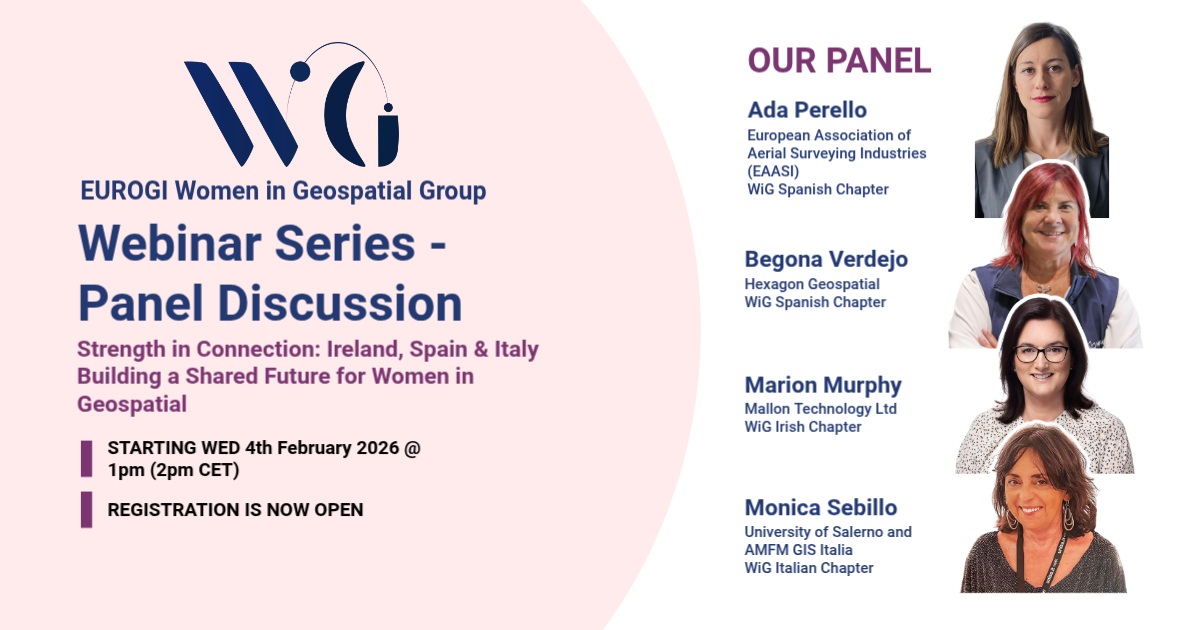
This spirit was recently showcased in our joint webinar, which brought together the Irish, Italian, and Spanish chapters. The panel engaged in a deep dive into careers, leadership, and the future of the geospatial sector from a unified European perspective.
Kicking off 2026 with “Strength in Connection,” the discussion highlighted how national initiatives can learn from one another while contributing to a shared European vision.
Catch Up on the Discussion
If you missed the live session on Wednesday, 4 February, the full recording is now available!
- Topics Covered: Career pathways, leadership strategies, and the evolving geospatial landscape.
- Speakers: Marion Murphy (Irish Chapter), Monica Sebillo (Italian Chapter), Ada Perello and Begoña Verdejo (Spanish Chapter)
- Moderator: Francesca Piatto (EARSC)
- Watch Now: https://www.youtube.com/watch?v=ub0pQX7PW8g